



ChromaGS

Text-Driven Semantic Editing of 4D Gaussian Avatars

1Universitat Politècnica de Catalunya (UPC) 2Institut de Robòtica i Informàtica Industrial, CSIC-UPC
Universitat Politècnica de Catalunya (UPC) Institut de Robòtica i Informàtica Industrial (IRI) Consejo Superior de Investigaciones Científicas (CSIC)

Accepted for Oral presentation at the International Conference on Computer Graphics and Image Processing (CGIP 2026) Acceptance rateNot disclosed by the organizers Oral rate100%

01 — Overview

Recolor an animatable avatar with words.

Given a trained animatable 3D Gaussian head avatar and a free-form instruction such as “red matte lipstick” or “skin lighter and green eyes”, ChromaGS recolors exactly the requested semantic regions in about 50 ms, directly at render time: no retraining, no diffusion, and the same result every time.

Teaser: an original avatar passes through ChromaGS (SAM3, Gaussian model training, text prompt decomposition and Gaussian rendering) and is edited with three prompts: (b) 'give me much darker eyebrows', (c) 'I wanna have my hair dark' and (d) 'skin lighter and green eyes'.
Real-time, language-guided color editing of 3D Gaussian head avatars. Given a trained avatar (a), users instantly modify the colors of semantic regions through natural-language instructions, (b) “give me much darker eyebrows”, (c) “I wanna have my hair dark”, (d) “skin lighter and green eyes”, with edits applied directly at rendering time, bypassing the need for per-edit optimization.

Abstract

We present ChromaGS, a method for real-time, language-guided color editing of animatable 3D Gaussian head avatars. Given a trained animatable avatar, users can instantly modify the color of semantic regions through natural language, with edits applied at render time and no retraining required.

Our key insight is to augment each Gaussian primitive with learned soft assignments to semantic regions and decompose colors into region-level base colors and Gaussian-level residuals. This decomposition enables coherent color transfer: modifying a region’s base color propagates naturally through all associated Gaussians while preserving fine appearance details encoded in residuals. A two-stage language pipeline translates text instructions into target colors, supporting both absolute specifications and relative adjustments. Unlike generative editing methods that may introduce unintended modifications, our approach provides deterministic, precisely localized semantic control. Experiments demonstrate faithful appearance preservation and intuitive interaction across diverse subjects.

Method

ChromaGS builds on a FLAME-bound animatable Gaussian avatar. Gaussians learn which region they belong to from SAM3 masks, and what color they show is split into a shared region base color plus a local residual. A text instruction is turned into new base colors, which are swapped in at render time.

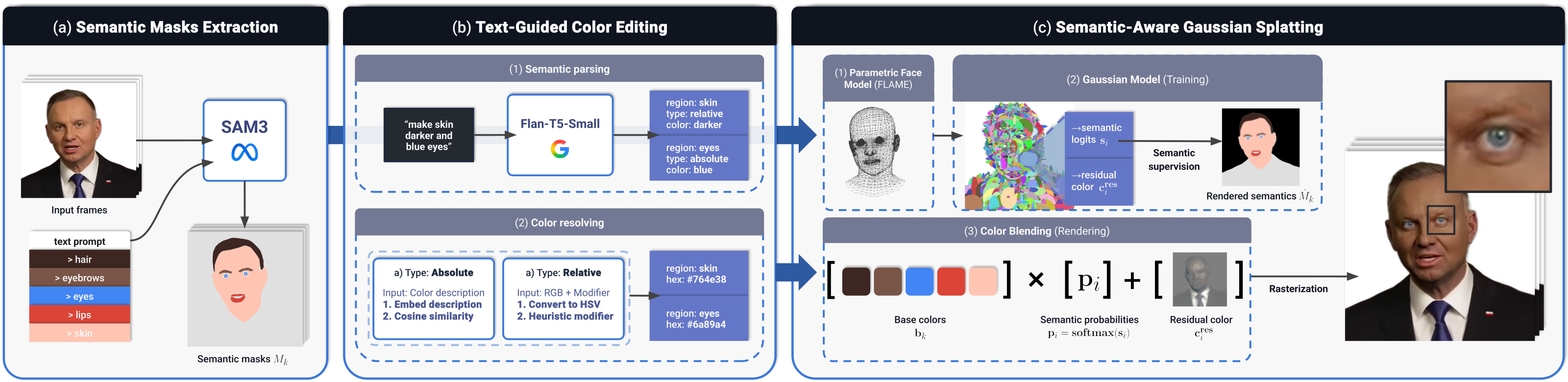
Overview of ChromaGS. (a) Semantic masks extraction: input frames and text prompts (hair, eyebrows, eyes, lips, skin) are fed to SAM3, producing semantic masks. (b) Text-guided color editing: (1) semantic parsing with Flan-T5-Small turns 'make skin darker and blue eyes' into region/type/color triplets; (2) color resolving handles absolute colors (embed description, cosine similarity) and relative modifiers (convert to HSV, heuristic modifier), yielding hex colors per region. (c) Semantic-aware Gaussian splatting: (1) FLAME parametric face model, (2) Gaussian model training with semantic logits and residual colors under semantic supervision, (3) color blending at rendering: base colors times semantic probabilities plus residual color, followed by rasterization.
Overview of ChromaGS. (a) SAM3 extracts semantic masks from input frames. (b) Text-guided editing: Flan-T5-Small parses instructions into structured text; a resolver handles absolute colors (palette lookup via embedding similarity) and relative modifiers (HSV shifts). (c) Gaussians learn semantic logits (supervised by mask cross-entropy) and decompose color into base colors bk plus residuals; editing replaces bk while preserving fine details in residuals. Click to enlarge.
(a) · Semantic masks

Open-vocabulary segmentation with SAM3

For each semantic class (hair, eyebrows, eyes, lips, skin) and each training frame, SAM3 is prompted with text to produce a binary mask Mk. Iris masks are obtained from the eye masks by detecting ellipses and warping an annular template.

Masks are made mutually exclusive by prioritizing smaller regions (e.g. iris over sclera) to ensure proper layering. SAM3 is temporally consistent, and since supervision is aggregated over hundreds of frames, occasional segmentation noise is naturally absorbed during training.
(b) · Text-guided color editing

Parse, then resolve

Semantic parsing. A fine-tuned Flan-T5-Small turns the instruction into a structured string region, color, type, with multiple edits separated by semicolons. This small output space is far easier to learn than direct RGB prediction.

“make skin darker and blue eyes”
→ skin, darker, relative; eyes, blue, absolute

Color resolving is deterministic:

  • Absolute (“olive skin”): the description is embedded with all-MiniLM-L6-v2 and matched by cosine similarity against region-specific palettes of anatomically plausible colors (e.g. Fitzpatrick skin tones, melanin-based iris colors).
  • Relative (“darker”, “more saturated”): the current region color is converted to HSV and shifted by deterministic modifiers.
(c) · Semantic-aware Gaussians

Semantic logits and color decomposition

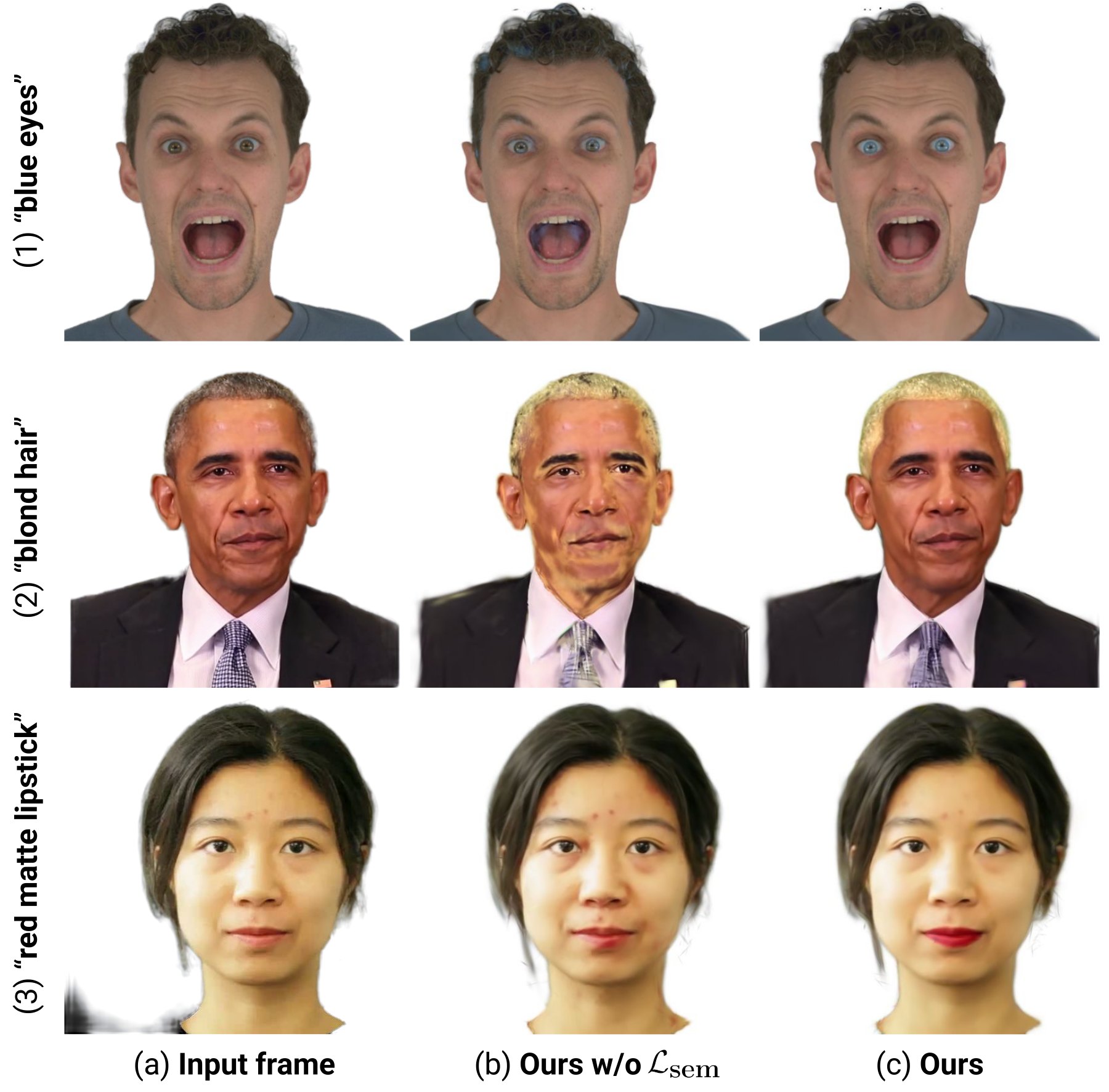
Each Gaussian gets semantic logits si ∈ ℝK with soft probabilities pi = softmax(si), rendered with the differentiable rasterizer and supervised by a pixel-wise cross-entropy against per-class blurred masks. Its color is a semantic blend of region base colors plus an expression-dependent SH residual:

cifinal = Σk pi,k bk + cires

Editing simply swaps base colors, so only the targeted regions shift while residuals keep the details:

ciedited = cifinal + Σk pi,k (bktarget − bk)

Cross-region adaptation: classes are weighted mixes of mask channels (e.g. skin also draws on lips at 0.3 and eyebrows at 0.2), so a skin-tone edit shifts pigment-correlated regions coherently.

02 — Results

Localized, deterministic edits that keep the person.

Compare each unedited avatar with its recolored counterpart. Both are rendered from the same trained avatar and driven by the same pose and expression sequence: the edit is just a change of region base colors applied at render time.

Qualitative results

Identity

Edit prompt

Drag across the video to move the divider: the left side shows the unedited avatar, the right side the edited one. With the viewer focused, use ← → to move the divider and Space to play or pause.

Unedited “red matte lipstick”
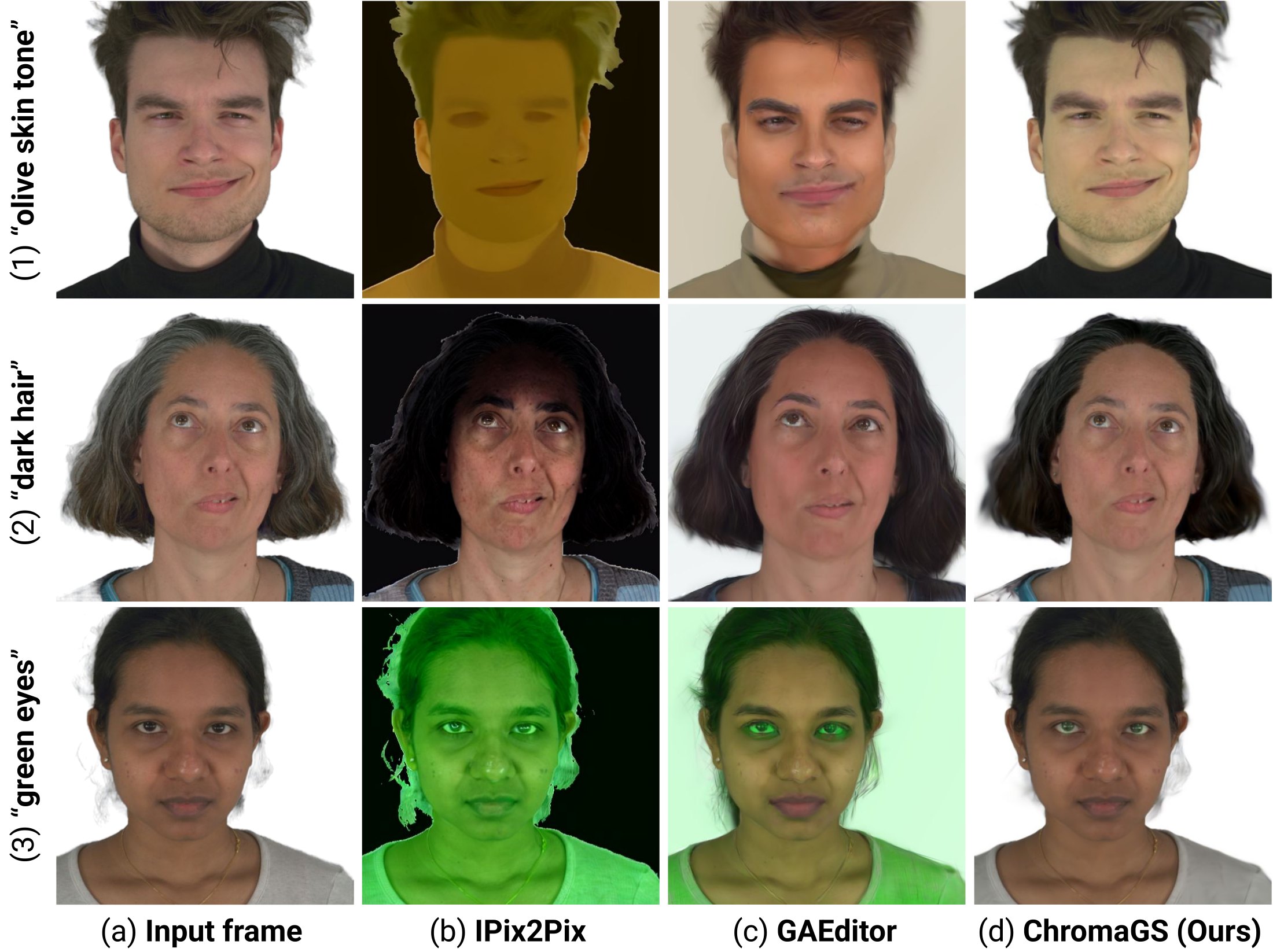
Three subjects edited with (1) 'olive skin tone', (2) 'dark hair' and (3) 'green eyes': (a) input frame, (b) InstructPix2Pix, (c) GaussianAvatar-Editor, (d) ChromaGS (ours).
Qualitative comparison for skin, hair and eye edits across three subjects: (a) input frame, (b) InstructPix2Pix, (c) GaussianAvatar-Editor, (d) ChromaGS. Our method produces localized, natural color changes that preserve identity and fine details (e.g. specular highlights, skin texture). Both GaussianAvatar-Editor and InstructPix2Pix exhibit color bleeding into unrelated regions and over-saturated tones.

Quantitative results

Comparison with baselines (Table 2 of the paper) on the pre-trained scenes publicly released by GaussianAvatar-Editor. Each scene is edited with 14 diverse color edits spanning hair, eyes, skin, lips and eyebrows, yielding about 10k edited frames per method at 512 × 512.

CLIP measures image–text alignment (averaged over ViT-L/14, ViT-B/16 and ViT-B/32), Identity is the ArcFace cosine similarity between edited and unedited renders, and Context is 1 − LPIPS outside the target region. ChromaGS achieves substantially higher identity and context preservation, reflecting its ability to confine edits precisely to the target region. The baselines’ slightly higher CLIP scores reflect a limitation of the metric itself: a diffusion editor that tints the entire face green when asked for “green eyes” produces a stronger global color signal that CLIP rewards, even though the edit is spatially incorrect.

Editing speed

Runtime comparison (Table 1 of the paper). ChromaGS pays a one-time training cost and then decouples editing from optimization entirely.

InstructPix2Pix 2D, per frame

Train
N/A
Edit
~400 ms / frame
Render
N/A

No per-subject optimization, but every frame is processed independently by diffusion: no 3D awareness, limited throughput and severe temporal flickering.

GaussianAvatar-Editor 3D, per edit

Train + Edit
~800 s (coupled)
Render
>100 FPS

Editing and training are coupled into a single optimization loop that must be repeated for every new edit.

ChromaGS (Ours) 3D, at render time

Train
~800 s (once)
Edit
~50 ms
Render
>100 FPS

Once trained, any color change is applied in ~50 ms (mostly language-model inference), three orders of magnitude faster, enabling interactive exploration of diverse edits.

03 — Code

Code release.

Coming soon

The full code for ChromaGS will be available soon. We are currently cleaning up the repository and preparing the release.

If you need the code sooner (for instance, to run comparisons for an upcoming submission), please feel free to open an Issue in the repository. Knowing there is active demand will help us prioritize and expedite the release process!

04 — Acknowledgments

Acknowledgments.

This work has been partially supported by project PID2023-151184OB-I00, funded by the Ministerio de Ciencia e Innovación (MCIN) / Agencia Estatal de Investigación (AEI) / 10.13039/501100011033, by the European Social Fund (ESF) “Investing in your future” and by ERDF, EU; and by the industrial doctorate 2021 DI 00102 funded by the Government of Catalonia.

05 — Cite

Citation.

If you find our work useful, please consider citing it:

BibTeX
@inproceedings{canela2026chromags,
  title={ChromaGS: Text-Driven Semantic Editing of 4D Gaussian Avatars},
  author={Canela, Antonio and Sanchez-Riera, Jordi},
  booktitle={International Conference on Computer Graphics and Image Processing (CGIP)},
  year={2026}
}